Tuesday, October 3, 2023

31 Days of Horror Reviews: The Dybbuk (1937)

Day 3: The Dybbuk (1937), dir. Michał Waszyński

Streaming Availability: Public Domain

The Dybbuk is the most important film about the specifically Jewish, specifically Kabbalist conception of demons. We know our Christian demons very well, they've filled pop culture. The Dybbuk, however, is a bit more obscure. I grew up in a secular Jewish home and I never feared this monster.

The Dybbuks emerge in the Middle Ages as souls of the dead turned foul. The word "dybbuk" means "clinging", as in the dead holding onto living bodies. With the mysticism Kabbalah came a more spiritual and fantastic view of the universe. There are Rabbis who are treated as saints, good spirits who can be summoned to aid the living. But with good spirits come evil spirits. Like the Christians, Jews perform exorcisms against their demons.  Notably, however, even in the classic exorcism tales, there's a mark of Jewish bitterness and cynicism. The rituals are not always successful. The great Rabbi Isaac Luria, immensely important in shaping Kabbalah, failed to save a young woman possessed by a wicked uncle in a famous episode. The demon choked her to death. And Dybbuks have not disappeared. Exorcisms still happen in the modern day, there was a 1999 exorcism performed in Dimona, Israel, and you can find videos of that event online.

As for our movie today, The Dybbuk is not the most explicitly "horror" film you'll find about Jewish demons. It is really more of a tragic romance with ghostly elements than a movie made specifically to scare its audience. It is an adaptation of a 1910s stage drama of the same name by the Russian Jewish playwright, S. Ansky. That play continues to be performed regularly today, and not because of spookiness. But The Dybbuk is a terrifying movie for reasons beyond its actual text. Its historical context is what is most disturbing.

The Dybbuk is a 1937 Yiddish film shot in a town called Kazimierz Dolny in the Second Polish Republic. By the end of 1942, with Poland now-erased from the map, the Nazi butchers would declare that Kazimierz Dolny was officially "free of the Jews" after most of its inhabitants were gassed in the extermination camp, Belzec. And while some Jews of Kazimierz Dolny would survive the war, the Yiddish film industry would never recover. Its speakers would flee around the world, and the language (a Germanic tongue) would lose much of its cultural prominence compared to Hebrew. The stars of The Dybbuk, Leon Liebgold and Lili Liliana, were lucky to have been in the US in 1939 at the start of the war. Today they are buried together as husband and wife in a cemetery in Queens. Many of the cast members were not so lucky.

That means The Dybbuk finds itself in a heartbreaking place as one of the last documents of a world that would be destroyed. You can hear the song of a cantor who would die in the Warsaw Ghetto. The shtetl life of the Ashkenazi Hassidim is depicted in great detail, from a Rabbi's court to the various minor details of a wedding ceremony's hymns and prayers. The Dybbuk was not meant to be a documentary, yet it finds itself as an invaluable historical artifact. Perhaps even the filmmakers were aware how tenuous this form of life would be and felt they had to show what they could before the nightmare to come. This film is a terrible reminder that the Nazis might have been defeated, but they were unsuccessful in their deranged schemes. My own grandparents lost their entire families and would never have a home in Poland again.

Now as for The Dybbuk the movie, it's the story of star-crossed lovers, Khannon (Liebgold) and Leah (Liliana) each the children of two best friends who were promised to each other before their births. When this promise is ignored by Leah's father, Sender (Mojżesz Lipman) for a more profitable match, Khannon turns to despair. Already a boy dangerously obsessed with Kabbalah and fasting, he summons Satan to toss away his life. He willingly becomes a Dybbuk to possess Leah, to have her in death if he cannot have her in life. And intriguingly, The Dybbuk imagines this as an almost heroic act, since Leah will later join her lover in the conclusion of the film, rejecting her Rabbi's exorcism and choosing death as well. Again, Jewish exorcisms are often failures. The story becomes a kind of Romeo & Juliet with ghosts, it's a solid drama.

As a horror film though, The Dybbuk only occasionally scary. We never see any Satan or ghosts or demons on screen. The only supernatural figure is Meszulach (Ajzyk Samberg), a mysterious man who wanders in and out of the plot. He's this stern creature, almost Rasputin-like, with terrible knowledge of what is to come but no little interest in stopping it. I believe he is meant to represent the divine forces in this drama, which are disturbingly ambivalent and inscrutable. The most scary scene of The Dybbuk is the wedding, where Leah, an unwitting bride, imagines her Big Day as this moment of chaos. The poor beggers invited in are a nasty grasping horde. Leah finds herself dancing with a figure dressed as Death. The film turns very German Expressionist in these instances.

But horror or not, The Dybbuk is an extremely important film. Yiddish literature is full of many stories like this of unhappy marriages born of village politics and the supernatural forces that pray on the miseries of heteronormativity. The Dybbuk is not just a classic film in a doomed world, it's the best movie depicting that topic. And I love the imagination involved of using demons not as purely negative scourges of humanity, but vehicles for romantic escape, a kind of triumph beyond reality. The current version of this movie was a heroic effort of restoration cobbled together from a dozen or so badly damaged incomplete prints. It is a miracle we have The Dybbuk today.

Next Time! In place of movies that are a hundred-years-old, how about ones that are merely fifty-years-old? We got a big one tomorrow, Rosemary's Baby.

Monday, October 2, 2023

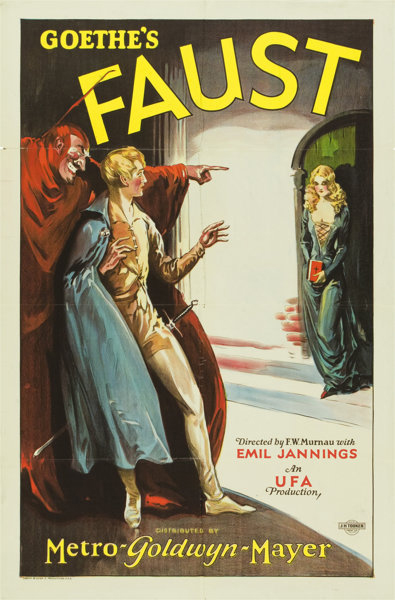
31 Days of Horror Reviews: Faust (1926)

Day 2: Faust (1926), dir. F. W. Murnau

Streaming Availability: Public Domain

We're going to have to fast-forward very quickly to the second half of the 20th century during this series. Unfortunately, demons were just not a major concern of horror films before Rosemary's Baby and The Exorcist built their role in pop culture. The Devil before the Seventies seems like a figure people were just not that scared of. In movies the Devil is mostly a silly trickster figure whose various schemes are foiled by technicalities in the end. He appears in comedies like The Devil and Daniel Webster or Bedazzled or Damn Yankees!, none of which are horror movies. He's fast-talking, he's charming, he's mildly queer-coded, but he's harmless. It's going to take some time before demons in film are real threats.

Today though we're still in the Twenties, and we do have a heck of a movie about Satan's dealings involving one Dr. Faust and his eponymous bargain. This is Faust, sometimes called "Faust: A German Folktale" coming from that brief moment of peace called the Wiemar Republic. It is directed by none other than F. W. Murnau, still famous today for his earlier film, Nosferatu. Just as Murnau can claim to have made the ur-vampire movie, he's also made the ur-devil movie. Faust is a classic example of German Expressionist filmmaking, easily the most technically impressive and ambitious silent horror film I've ever seen. It was the second most expensive German silent film ever, behind only Metropolis. It is going to be many decades before we see a blockbuster of this scale again involving the Devil or his cohorts.

The legend of Faust is a medieval German tale that traces back to the 16th century. It seems there may have been an actual Johann George Faust who lived about a century earlier, who was an alchemist and oculist, but everything about him is murky and unclear. It's possible there never was such a person. By 1604 the legend was famous enough for Christopher Marlowe to have written a play called The Tragical History of Doctor Faustus. The most important Faust work comes in the early 1800s, with Johann von Goethe's play Faust, which is the direct inspiration for this film. Dozens of other versions of the tale exist across literature and stage plays and films, there's even a Faust comic book superhero. (There's a Faust superhero movie which is... quite a thing, we might have to cover that this month.)

Altogether this figure is the classic example of the Deal with the Devil. It's always the story of an old scholar regretting his dull nerdy life, so making a deal with the dark forces for restored youth. This kind of bargain is not exclusively Christian, Jinns in other cultures play similar roles. But with Faust, we always end up with a Christian message that life's pleasures are unsatisfying. Faust usually wiggles out of it and returns to God's grace.

Before he screws over the demons, we can get a lot of the Devil being a horrible little bastard and that's where the real joy lies. F. W. Murnau's own feelings of faith are hard to judge. He was gay in an era where such things were absolutely not reconcilable with faith. I suspect that much like Häxan, it was not the message that driving the filmmaking, but rather the technical exercise. Faust's scale and beauty are worthy goals in of themselves. It's a great achievement in special effects and gorgeous shot compositions.

We open up on a scene of Mephisto (Emil Jannings) in shadow. The Devil is massive in the frame, his dark wings crushing his body, almost like he's a head buried in a dark mountain. Disney would be inspired heavily by these images when he made Fantasia in 1940. Mephisto is met by The Archangel (Werner Fuetterer), an equally impressive figure with huge wings, holding a vast spiky sword. These two kaiju-sized beings are a contrast of good and evil clearly defined. I love that we have 4K restorations of Faust available, because now we can really see how brilliantly the light and shadows play together in on the silver nitrate film stock. (I'm also extremely thankful this movie survived where so many silent films did not.) These two figures with their exaggerated operatic poses are something you do not see much in movies, it's more a comic book double-panel moment or something you'd find in the rich illustrations of manga.

Mephisto and the Archangel drew up their game, a Book of Job wager that the Devil can tempt good Dr. Faust to reject God. To launch his scheme, Mephisto towers over a small German village. You can see his awful face fill the sky for the villagers, they are less than insects before this diety. The Devil reduces himself to mere human-scale to be able to speak to Faust, now allowing Emil Jannings to really camp it up across the screen as this cackling, wonderful villain. The devil's costume with an intense widow's peak and black cape may reminds one of a certain Bela Lugosi, in fact. Faust himself is played by Gösta Ekman, only in his thirties at the time, but playing the in an incredible old-age costume initially. You'd never believe that Old Faust and Young Faust are the same person, but you can accomplish a lot with a massive beard and stage make-up. Modern films are utterly unable to pull off an age make-up this impressive.

The first hour of Faust is just a non-stop blockbuster of special effect after special effect. We see Mephisto briefly return to his god form and he suddenly grows to fill Faust's room floor to ceiling. They have a magic carpet ride across fantasy miniature landscapes. There's a sophisticated crane shot where a bridge full of dancers play in the background as the camera pans down through three levels in the foreground, all in focus. This is where we meet the beautiful Duchess of Parma (Hanna Ralph), now tempted by this mysterious prince Faust who has appeared from nowhere with a menagerie of elephants. (I guess not only Fantasia was inspired by Faust, this is extremely Disney's Aladdin, isn't it?)

Unfortunately, the second hour is less spectacular as Faust finds himself in his home involved in a romance. He wishes to woo a pure maiden, Gretchen (Camilla Horn). The set-up and follow-through of this tragic romance is solid but less spectacular. Camilla Horn gets to do a lot with the brutal despair her character is put through. Mostly the joy is with Emil Jannings getting to fill the space with ham and wickedness, he's so great as the Devil. What a star. Even the plainer scenes of simple German peasant life are full of the intense angular style of Expressionist filmmaking. I really enjoyed most of Faust, even if Gösta Ekman has more to do as Old Faust than Young. It's a great find, movies like this are why I do this series every year.

And the conclusion of Love Conquers All is some nonsense as far as this author is concerned. I'll forever be ever in the devil's corner if he's a fun wicked fellow. But again, Faust the story is not the draw. It's the imagery, its the artistry, which are amazing. Faust is a work of incredible art. It's the kind of movie that makes you sad that the silent era will end in just a few years and the invention of sound will demand far less technically impressive filmmaking. We will not be back here for decades yet.

Next Time! We jump to the 1930s and the world of sound with a Yiddish tragedy of the demonic, The Dybbuk.

Sunday, October 1, 2023

31 Days of Horror Reviews: Häxan

Day 1: Häxan (1922), dir. Benjamin Christensen

Streaming Availability: Public Domain

Häxan is a 1922 film from Denmark, so it is of course, silent. More curiously, it's a documentary, written in a style akin to a video essay. Its hour forty minute runtime is divided into various acts of evidence and argument that lead to a conclusion. The director, Benjamin Christensen, speaks in the first person in the text. We're not grading this film as a five paragraph school assignment, however. We're looking to see what kinds of scares are at play here and there are plenty. If you're a garage band and need some free spooky B-roll for your music video, Häxan is an invaluable resource of cool imagery.

The impressive thing about Häxan is its extremity for the time. Most of the hardcore features of exploitation films do not become common until the Sixties. That's when taboos recede and technology increases to really show off gore. A lot of horror movies before then are (let's be honest here) rather boring and dull to us 21st century folk. Silent films are an even harder adjustment. But Häxan is not slow, even at 105 minutes, which is an epic length for this era. It's full of fantastic sights, intense horrors, and quite a few naked asses. Christensen is putting on a great show of special effects and nightmarish visuals to decorate his essay.

Which kinda leads me to my suspicion here. Was Benjamin Christensen really out to make a non-fiction history piece? I'm sure he actually was fascinated by medieval mysticism and witch-hunting manuals, specifically the Malleus Maleficarum. But his interest is mostly in the lurid details, the exploitation potential here. A non-fiction pretense gives you a lot more liberty to depict all the gross horrors of witchcraft and medieval torture practices. And even then, Häxan was controversial in its time, which was relatively liberal in filmmaking circles. (By the 1930s, a movie like this would be unimaginable to release.) Variety Magazine in 1923 called it "absolutely unfit for public exhibition". To which I say, Hell Yeah.

Witchcraft is a perfect subject for exploitation. You win both ways in terms of horror. You can film both the outrageous fantasy of the Satanists and their Sabbaths. And then you can film the other side, with the barbaric and depraved methods used by the clergy and the state to root out witches.

For me though, the joy in Häxan is not the opening slideshow of old manuscripts or the Kafkaesque nightmare of church justice. (Or even stunningly erotic fascination with whips.) It's when this movie stops really being about any argument at all and just wallows in the grimy wonders that is Satan and his works. Benjamin Christensen is so under Satan's thrall that he actually plays him in the movie. He's as a naked hairy barrel-chested man constantly flicking his tongue in a rather Metal display. I love all the demons in Häxan, from the adorable little stop-motion Baphomet to the host of costumed freaks climbing out from under an old woman's dress as she gives birth to them. The shots are dark and full of texture. This rules. All these images are timeless, even without accompanying sound. They're very cute now but still have power.

Häxan tries to have its cake and eat it too in terms of witchcraft history. "People's belief in him [Satan] was so strong that he became real", admitting that there is no Devil. Yet it kinda admits to some actual magical practices. Also it shows so much detail to the dark arts in sophisticated special effects that you might forget you're seeing what the movie says is pure fantasy. Audiences in 1922 would probably be too terrified by the imagery to notice much of the subtlety here.

To be clear: there were no medieval witches. Nobody was worshiping Satan in the 1980s, nobody was worshiping him in the 1480s. All of it was paranoia, and thousands died for nothing. The inquisitor, Heinrich Kramer, who wrote the Malleus Maleficarum was - to put it bluntly - fucking nuts. He was so sexually obsessed with an Innsbruck woman who dared challenge him that the local bishop had him kicked out. Witches are fun, black Sabbaths seem like a great way to spend the evening, the visions of Hell even in Häxan are delightful, but none of it happened. There is not even evidence of much surviving folk Paganism in Western Europe at this point.

Häxan exaggerates the death toll by the witch hunts claiming eight million murders which would be preposterously high even in 1922's scholarly consensus. Today the figure is a (still horrible) 60,000 or so. Still the film is accurate with its awful collection of torture instruments. We do not see many of them used, but their mere implication makes Häxan something akin to the great-great-grandparent of the torture porn sub-genre. From Heinrich Kramer we get Saw's John Kramer.

There is a feminist conclusion in Häxan. Christensen notes that the medieval injustices against women have only evolved into modern injustices. He sees how scientific theory explains the behavior of witches psychologically, but also how modernity has conjured its own forms of torture. Women are called "hysterical" and locked away in terrible conditions. So even in an age without Satan, evil persists. And well, Christensen would live to see how right he was. Häxan is only a generation ahead of the Second World War when that eight million death toll would be far more accurate, and psychiatry would play a terrible role in promoting euthanasia on the path to mass-genocide. Fifty years later, bunk science of memory regression would conjure up our very own witch hunts in the Satanic Panic.

But that kind of nightmare does not have a big Satan with his tongue out. It's not fun. Häxan, however, is a great opening to our month of demons. We have so much more devilry to come in many more forms.

Next Time! Just one more silent movie, I promise you. It's the German Expressionist blockbuster, Faust.

Saturday, September 30, 2023

31 Days of Horror Reviews 2023: Master Post!

You feel it in your bones. The temperature has dropped. Empty stores have become full overnight. Gobbler sandwiches are back at your local Wawa. It is SPOOKY SEASON once again!

Last year we did a history of Vampires in film, so there were several logical choices for the sequel. Werewolves are the vampire's romantic rival. There's the other great Universal Horror monster, Frankenstein. Even zombies would have made sense. But no, this October we have the release of The Exorcist: Believer, the fifth or sixth (it's complicated) entry in The Exorcist film franchise. So 2023's topic for Spookiness shall be DEVILS AND DEMONS.

The Exorcist in 1973 is the classic example of demonic cinema. It is not the first movie about a possession, it is not the first movie concerned with the devil invading modernity, but it is the movie that made America terrified of demons again. Only a decade later the United States and then later much of the world would be swept by actual claims of Satanic cults targeting children. All of which was nonsense, the victims were the accused, it became a shameful modern recurrence of medieval witch hunts. All Jaws did was depress the economies of a few beach towns, The Exorcist induced truly destructive paranoia. So maybe it is indeed, the scariest movie ever made.

We'll get to that movie within the first week, there's a handful of precursors we must visit first. Ffter The Exorcist, demons never really leave horror cinema. Odds are today, if you're going to see a horror movie, the topic is most likely going to be about a supernatural entity invading your house. This what The Conjuring Universe is all about, and all the thousands of movies just like it. Demons are more popular than ever, and sadly just as generic.

The question therefore is, what is a demon? The devil is a demon, the chief demon. Specifically what separates a demon from say, a ghost or the undead or beasts, why are they special? Well, for our purposes, I imagine a demon as an evil spirit that can possess a place or person. They either have no physical form or only rarely can take one. Satan AKA Lucifer AKA *the* Devil is going to be our most prominent demon, but he's hardly alone here. If your culture looks to mystical powers for good in the world, it probably also looks to similar powers that cause evil. So there's demons in Judaism, there's demons in Ancient Egypt, Jesus Christ worked as an exorcist, there's demon in East Asia, there's demons in India.

I'd prefer for this series to focus on "real" demons, as in actual things inspired by folklore. There's plenty of Baguls in cinema, totally made-up creatures that follow the tropes of demonology but without any history of culture. These are less interesting to me. I like that Satan has a history going back thousands of years, was not even originally a demon in the Old Testament, and has evolved and transformed into the red-skinned pointy-bearded fellow we have today.

But also, this is cinema. Demons are scary, sure, but there's a reason we love to see them on the big screen. Satan is nothing if not charismatic. A demon is liberation, they can be joyful chaos, they can just be fun dudes. They're a necessary reaction against the moral conservatism of societies. Both the most awful thing they can imagine, yet also a wish. Maybe they're symbols of sickness and decay and death, maybe they're little freaks out here with horned tails and their tongue sticking out. Demons are fun.

So we're starting with a film made over a century ago, and will end on Halloween with a movie not yet released by the time of this writing. That's a solid history, I feel.

1. Häxan

2. Faust (1922)

3. The Dybbuk

4. Rosemary's Baby

5. Look What's Happened to Rosemary's Baby

6. The Devil Rides Out

7. The Devils

8. Belladonna of Sadness

9. The Exorcist

10. The Exorcist III

11. Beyond the Door

12. The Omen

13. Omen II & III

14. Alucarda

15. The Visitor

16. Hellraiser

17. Hellbound: Hellraiser II

18. Prince of Darkness

19. Angel Heart

20. The Prophecy (1995)

21. Wishmaster

22. Noroi: The Curse

23. The Exorcism of Emily Rose

24. The House of the Devil

25. A Dark Song

26. Hereditary

27. When Evil Lurks

28. The Medium

29. It Lives Inside

30. The Exoricst: Believer

31. Tales From the Crypt Presents: Demon Knight

Sunday, August 20, 2023

'Final Fantasy XVI' Did Not Need to be HBO, it Needed to be Final Fantasy

Final Fantasy XVI is not the game I needed it to be.

Final Fantasy XVI, however, seems to be the game that Square Enix and Sony needed it to be. It is a high-quality product that shows off the power of the PlayStation 5’s graphical muscles with thrilling gameplay. Square Enix has been happy to report three million sales in the first week of release. Even the online discourse around the game has been mixed but leaning to positive, maybe overly positive. If you come at this game with a critical lens towards its clumsy handling of slavery, you’ll find a caustic audience shouting you down. Gita Jackson’s nuanced review at Polygon was met with the online equivalent of boos and tomatoes. (Gaming discourse is not at a high ebb in 2023, needless to say.) So, for better or worse, let’s count Final Fantasy XVI as a "W" in Square Enix’s favor.

As for ol’ BlueHighwind here, Final Fantasy XVI is simply not good enough to "shut my brain off" about. At no point does the game ask that of you. This title is is desperate to prove its seriousness, copying Game of Thrones' style at its most grim and cheerless. Final Fantasy XVI wanted to combine themes of environmental disaster with class warfare in complex dance of polities fighting for resources. The bitter fact is that none of that lands. I cannot pretend the game is not trying for something bigger than usual anime tropes of teenager friendships destroying God. Of course, Final Fantasy XVI does end up in exactly that mode by the end, in spite of itself falling right back into franchise cliches. (And who said these cliches are bad anyway?)

The more damning problem with Final Fantasy XVI is that it is a forty hour game. Sometimes it’s an explosive thrill ride leading easily from one adventure to the next. Often it is a ponderous slog of unnecessary filler. If every moment of this game was just watching our hero Clive (Ben Starr) dudebro his way across preposterous action set pieces, I could cheer. When I’m stuck three feet in the muck of dull cookie-cutter sidequests, I can only see how limited the narrative apparatus is.